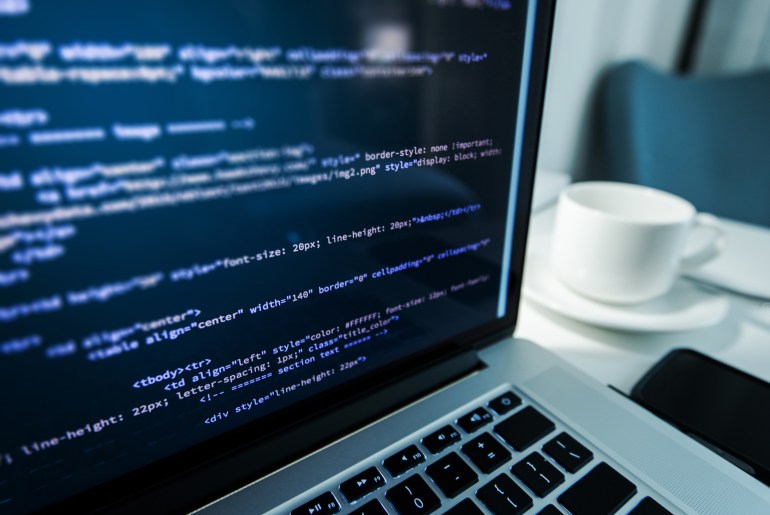
Python libraries are ready-to-use code packages that can be imported for use in various projects, saving developers from having to create all the code from scratch.
The Python language is extremely powerful and versatile, making it highly popular among developers, with an active community and a wide variety of specialized libraries.
Moreover, Python libraries play a crucial role in the development ecosystem using the Python language, providing a broad range of features and templates that facilitate application development.
In this article, we have compiled a list of 19 Python libraries that can be used for web development, data science, automation, and graphical user interface. Check out the complete list below!
Python Libraries for Web Development and API
To assist in the development of web applications and APIs in Python, there are several libraries and frameworks that facilitate robust and efficient construction. Check out some options:
1. Django
Django is a comprehensive and robust framework that provides a wide range of features and essential functionalities for web development. It includes an integrated Object-Relational Mapping (ORM), automatic administration, template support, and more.
2. Requests
Requests is a simple library for making HTTP requests in Python. It facilitates communication with APIs and web services when information needs to be requested or sent to a site.
3. Flask
Similar to Django, Flask is also a set of libraries. It is characterized by being lightweight and flexible, ideal for building simple web applications and APIs. It allows greater freedom and flexibility during application development.
4. FastAPI
A modern and high-performance framework, FastAPI is ideal for developing web APIs that use static Python typing, providing a more productive and secure development experience. Additionally, it supports automatic generation of interactive documentation and data validation.
Learn more: List of Python tools for practicing online
Python Libraries for Data Science and Artificial Intelligence
There are several libraries and frameworks with tools, algorithms, and features for analysis and modeling that are widely used for data science and artificial intelligence in Python. Take a look:
5. NumPy
NumPy is considered a fundamental library for those working with numerical computation in Python, as it enables data manipulation. It supports multidimensional arrays and essential mathematical functions for efficient numerical operations.
6. Pandas
Essential for those working with data science, this library is used for structured data manipulation, providing flexible data structures, transformation, and analysis of data.
7. PyTorch
An open-source machine learning library, PyTorch supports the construction and training of deep learning models, using a dynamic approach to artificial intelligence model development.
8. TensorFlow
An open-source library focused on creating artificial intelligence models, TensorFlow is a flexible and scalable platform for developing, training, and deploying deep learning models.
9. OpenCV
Widely used for computer vision and image processing, OpenCV offers a wide range of functionalities and algorithms for the analysis, processing, and manipulation of images and videos.
10. Scikit-learn
Scikit-learn is an open-source machine learning library designed to be simple and facilitate the implementation of machine learning algorithms for tasks such as clustering, regression, and dimensionality reduction.
Python Libraries for Automation and Scripting
To assist in automation and scripting in Python, there are several libraries and frameworks. They are responsible for facilitating task execution, interacting with systems, and aiding in the development of scripts for process automation. Here are some options:
11. Selenium
Selenium is a library focused on web automation, browser navigation, and testing. It allows the automation of processes on websites, interaction with web pages, form filling, clicks, and other automation actions.
12. BotCity
BotCity is an open-source RPA platform that combines multiple technologies such as UI manipulation via IDs, computer vision, and other strategies. BotCity provides a code assistant to automatically generate code based on specific actions taken by the RPA developer on the UI. Moreover, it is cross-platform and operates in any integrated development environment (IDE) like VSCode, allowing the development of automations in various environments – VMs, containers, desktop, etc.
The BotCity orchestrator enables the orchestration of Python automations in any framework: Selenium, PyAutoGUI, Robot, TagUI, etc. It has its own libraries for web and desktop automations, along with over 30 plugins for common RPA use cases.
It also features BotCity Web, a web automation framework that combines Selenium with Computer Vision to integrate with the web UI. Thus, RPA developers can choose the best approach to create intelligent automations, combining component selection and manipulation. All automations run in headless mode, even with computer vision.
Learn more: What is automation software and its benefits?
13. Scrapy
Focused on data scraping (web scraping), Scrapy extracts information from websites for your Python code. It is a widely-used open-source framework for building web spiders that collect information and store data in structured formats.
14. PyAutoGUI
A library for automating User Interface (UI) tasks on operating systems such as macOS, Windows, and Linux. It allows the simulation of mouse and keyboard actions and captures screen images.
15. PyODBC
PyODBC provides a programming interface to connect to databases using Open Database Connectivity (ODBC), which is a standard API that allows applications to communicate with relational databases, regardless of the management system.
16. Paramiko
A library for automating operations on remote systems via Secure Shell (SSH), enabling the execution of commands, file transfer, and system management in an automated manner.
Python Libraries for Graphic Interface Creation
To assist in creating graphical interfaces in Python, there are various libraries and frameworks that facilitate the development of applications with interactive and appealing user interfaces. Check out some options:
17. Tkinter
Tkinter is a standard Python library focused on creating graphical interfaces with fewer features. It is easy to use for the development of basic and intermediate applications. It comes with predefined widgets and offers easy integration.
18. Kivy
Kivy is a Python framework for developing multi-touch applications and graphical interfaces with support for touch input and gestures. Codes developed in Kivy can run on any platform, including Linux, macOS, and Android.
19. Dear PyGui
Geared towards the development of quick and simple applications in Python, Dear PyGui is designed to be easy to use and exhibits high efficiency in terms of performance.
How Many Python Libraries Are There?
The Python community is highly dynamic and continually growing, leading to the regular development of new libraries. This makes it challenging to provide an exact number of existing Python libraries.
However, as of the end of 2022, the Python Package Index (PyPI), the official repository of Python packages, had over 350,000 registered packages. In other words, the diversity of Python packages is enormous.
What Are the Best Python Libraries?
Knowing that there are numerous Python libraries, choosing the best one for your project can be challenging. Nevertheless, with research and the help of guides like this, you can select the best Python library for your project. Consider the following aspects when making this decision:
- Needs: Take into account your specific needs deeply. Consider the type of project being developed and identify the challenges;
- Documentation: Check if the libraries you are considering have documentation and resources that can guide you in project development. Libraries with code examples and tutorials aid in understanding their application;
- Efficiency: Consider if the chosen Python library is efficient in terms of speed, resource usage, and its ability to handle complex tasks;
- Updates: Look for Python libraries that are continually being developed. Examine the history of updates and bug fixes.
Ready to Work with Python Libraries?
We hope this article has provided valuable information about the main Python libraries used. Remember that the choice of library or framework depends on your project’s needs, personal preferences, and development prerequisites.
If you are looking for automation software for your company, consider exploring BotCity. The platform offers various Python frameworks ready to be used in your automation strategy. The solution also allows monitoring automations with alert and error notifications, task queue control, and management of virtual machines and containers in a single orchestrator.
Feel free to create a free account now or schedule a conversation with one of our specialists!