

Total Cost of Ownership (TCO) is a financial analysis metric that estimates all costs associated with an asset over its lifespan. Particularly useful for IT leadership to estimate the total cost of licenses, infrastructure, development, and support, TCO includes the initial purchase cost of a given IT solution, as well as operation, maintenance, and disposal costs.
It’s an important tool for decision-making, including in technical areas, as it helps companies compare different investment options and choose the one with the best cost-benefit ratio.
Focusing only on the initial cost of a product or service, many companies risk underestimating all the total costs involved, which should be considered especially in sectors where the longevity and efficiency of assets play a significant role.
Read more about the application and calculation of TCO next!
When to measure TCO?
TCO can be used to compare different investment options, such as hiring an outsourced service, implementing a new strategy or technology, or buying new equipment. TCO also helps leaders identify cost reduction opportunities, like adopting preventive maintenance practices or switching to a more efficient product. Moreover, it is a critical indicator for measuring asset performance by monitoring their associated costs.
What are the Components of TCO?
In general terms, Total Cost of Ownership (TCO) comprises the following components:
Initial and Infrastructure Cost: The initial cost is the purchase or implementation cost of the asset.
- Operating Costs: Operating costs are costs associated with the use of the asset. They include labor costs and leadership expenses, for example.
- Maintenance Costs: Maintenance costs are associated with maintaining the asset to ensure proper operation. They may include additional costs for services, support, costs related to errors and failures, and also additional licenses.
- Disposal Costs: Disposal costs are associated with disposing of the asset at the end of its useful life.
Later on, we will explore the specific nuances of TCO for IT and automation areas.
How to Calculate TCO?
Calculating Total Cost of Ownership can be challenging, as it involves considering all of the above factors. Here are some general steps that can help:
- Identification of Direct and Indirect Costs: List all costs associated with the asset, from acquisition to disposal.
- Life Cycle Assessment: Consider the useful life of the area or asset and distribute the costs over this period.
- Future Cost Estimation: Anticipate maintenance costs, updates, and potential indirect costs.
- Risk Assessment: Consider external factors that may affect costs, such as regulatory changes or technological advances.
But, if you want to make a simple calculation involving only the financial aspects, you can use the following formula:
TCO = Initial Cost + Operating Costs + Maintenance Costs + Disposal Costs
For example, if an asset costs $10,000 to buy, has annual operating costs of $2,000, annual maintenance costs of $1,000, and disposal costs of $1,000, its TCO would be:
TCO = 10,000 + 2,000 + 1,000 + 1,000 = 14,000
Some challenges in calculating TCO involve the difficulty of estimating long-term costs, such as disposal costs. In addition, the calculation requires accurate data on operating and maintenance costs.
TCO for RPA Automations
Since we are talking about the reality of technical and IT areas, let’s consider a practical example: the TCO of an RPA team or RPA Automation Center of Excellence (CoE).
In this case, you can consider the following aspects:
Licensing Costs
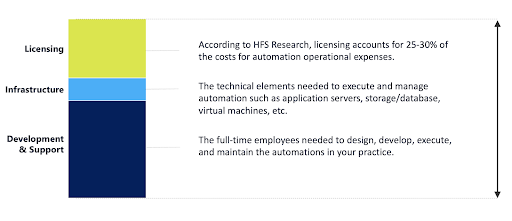
These costs represent about 25-30% of automation operational expenses, according to HFS Research. The challenge here is the variability in pricing models among RPA vendors. This includes the costs of licenses required for users to access the RPA tool and for the execution of automated processes.
Specific components of this cost can be:
- Number of RPA users (developers and operators)
- Number of unattended automations in production
- Number of attended automations in production
Other licensing costs associated with additional services of specific RPA tools.
Infrastructure Costs
Though they represent a smaller portion of RPA’s TCO, these costs are fundamental for any business case for RPA migration. It includes the technical elements needed to execute and manage automation, such as:
- Application servers for development, user acceptance testing (UAT), and production;
- Data gateway servers for analytics and monitoring of automation practice;
- Storage/database elements like SQL databases or file servers;
- Virtual machines required to run the automation practice;
- Hosting costs, which vary depending on the use of local or cloud setups;
- Additional service fees from consultancies, outsourcing organizations, or the RPA vendor itself.
Development and Support
These are the largest components of automation’s Total Cost of Ownership (TCO) and include the necessary resources to develop, maintain, and support the automation practice. This involves:
- Full-time employees needed to design, develop, execute, and maintain automations.
- Costs related to the complexity of the RPA tool used, which can directly influence these costs.
Causes of TCO Increase
The Total Cost of Ownership (TCO) in areas like Robotic Process Automation (RPA) is increasing due to various reasons, among them the rise in traditional RPA licensing costs and the growth of RPA teams.
Indeed, research indicates that organizations are expanding their automation teams. According to a Blueprint survey, half of them have already established RPA Centers of Excellence, and 40% of those who have not yet done so plan to do it soon. This leads to an increase in operational costs and RPA’s TCO.
Additionally, companies are expanding their RPA tool chains. Organizations report having an average of five tools in their automation chains. Besides the RPA platform, they use orchestration tools, testing suites, and process discovery tools.
Geographically, the United States is the largest investor in RPA, with average annual spending of $600,000, according to the same survey. Larger companies, especially those with over 5,000 employees, lead automation spending, with an annual average close to $550,000.
How to reduce TCO?
Using automation and RPA operations as an example, we’ve gathered some recommendations for technical areas to reduce the Total Cost of Ownership:
Migrate to More Cost-Effective Platforms
Many organizations are migrating to platforms with reduced licensing fees and greater flexibility for integration with various frameworks.
Eliminate Waste
Mature automation programs are auditing their RPA portfolios and eliminating redundant or underperforming processes, reducing costs such as licenses per robot, for example.
Measure Results
Measuring the operation’s results through customized dashboards and intelligence tools is also essential to monitor the operation’s costs, FTE, and other relevant metrics for stakeholders.
Who is Responsible for the TCO?
Regarding the responsibility for paying the RPA bills, historically there has been a close connection with IT departments, given the technical nuances of automation. Even with low-code RPA platforms, IT support and oversight are still essential.
It’s not surprising that 34% of survey respondents indicate that IT departments are the main stakeholders and sponsors of RPA, followed by Finance and Accounting.
Despite these costs, it’s important to consider the potential benefits of automation with RPA, such as:
- Cost Reduction: RPA automation can help reduce costs associated with manual tasks, such as data entry and order processing.
- Efficiency Improvement: An RPA tool can improve process efficiency, freeing up employees to focus on more strategic tasks.
- Error Reduction: It’s also possible to reduce human errors, which can cost companies money, through automation with RPA.
Optimize Your TCO in Automation Projects with BotCity!
Code-based RPA tools decrease RPA’s TCO, given that they have flexible licenses and do not require lock-in like low-code tools, and are more efficient. BotCity stands out with its code-based RPA orchestrator, the BotCity Maestro.
Our software has helped companies like Andrade Gutierrez save up to 100,000 hours in human work with RPA. The bots built with our tool are 3 to 20 times faster compared to low-code tools.
Want to know how to achieve excellent results in your company as well? Register for free on the BotCity website or schedule a conversation with us now!


